Industry & Code
BC Energy Step Code in Burnaby 2026: Step 3 + EL-4 Today, Step 5 by 2032
Burnaby's current energy code is Step 3 + EL-4, a measurable airtightness and zero-carbon target. Step 5 is the 2032 horizon and what some builders already deliver. Here's what each actually requires of the framing, the sheathing, the windows, and the ventilation.
When a Burnaby homeowner asks us about Step Code, they almost always mean: what does my new home actually need to hit? The short answer for Burnaby in 2026 is Step 3 of the BC Energy Step Code combined with EL-4 of the Zero Carbon Step Code, both in effect since January 1, 2025. Step 5 isn't the current Burnaby minimum; it's the provincial target for 2032 and what some builders, ourselves included, deliver voluntarily today.
This post is for the homeowner who wants to understand what Step 3 + EL-4 actually requires of the framing, the sheathing, the windows, and the ventilation right now, and what changes again as Burnaby and the province move toward Step 5.
What Step Code is, and what Burnaby actually requires
The BC Energy Step Code is a performance standard added to the BC Building Code in April 2017. It replaces the old prescriptive "build it this way" requirements with a measured outcome: the house must perform this well. The performance is verified through energy modelling and a blower-door airtightness test. There are five steps for Part 9 residential, with Step 5 the most stringent. Layered on top of it is the Zero Carbon Step Code, measured in Emissions Levels EL-1 (lowest) through EL-4 (strongest, "zero carbon").
The provincial baseline is Step 3 of the Energy Step Code plus EL-1 of the Zero Carbon Step Code for new Part 9 residential, Step 3 province-wide since May 1, 2023, EL-1 since March 10, 2025. That's the floor, the minimum to get a building permit anywhere in BC. Municipalities can adopt higher local requirements, and many have. The City of Burnaby requires Step 3 plus EL-4 for every new Part 9 residential building, in effect since January 1, 2025. EL-4 is the most stringent emissions tier, which in practice means new Burnaby homes must use zero-emission energy sources for space heating, water heating, and ventilation, heat pumps in, gas appliances on the way out.
Step 5, where this is all heading, is not "Net Zero." It is not Passive House. It does not require any specific equipment. It requires that the house, as built, hits a numerical target: a Mechanical Energy Use Intensity (MEUI) and Thermal Energy Demand Intensity (TEDI) below the published Step 5 limits, with airtightness measured at no more than 1.0 air changes per hour at 50 pascals (ACH50). The provincial roadmap targets Step 5 as the new-construction default by 2032. Some builders are delivering it today on a voluntary basis.
Step Code isn't a finish, it's a way of building. By the time you're choosing tile, the decisions that made the airtightness target possible were already made.
Icon Projects Team
The airtightness targets, 2.5 ACH50 today, 1.0 for Step 5
This is the single number that matters most to construction quality. A standard pre-Step Code home tested in the rough range of 3.5 to 7 ACH50. Step 3, Burnaby's current minimum, demands 2.5 ACH50 or better. Step 5 demands 1.0 or better. Step 3 is achievable by a careful framing crew with caulking, foam, and tape. Hitting 1.0 generally requires aerosol sealing on top of meticulous detailing, and the design needs to be written for it from the start.
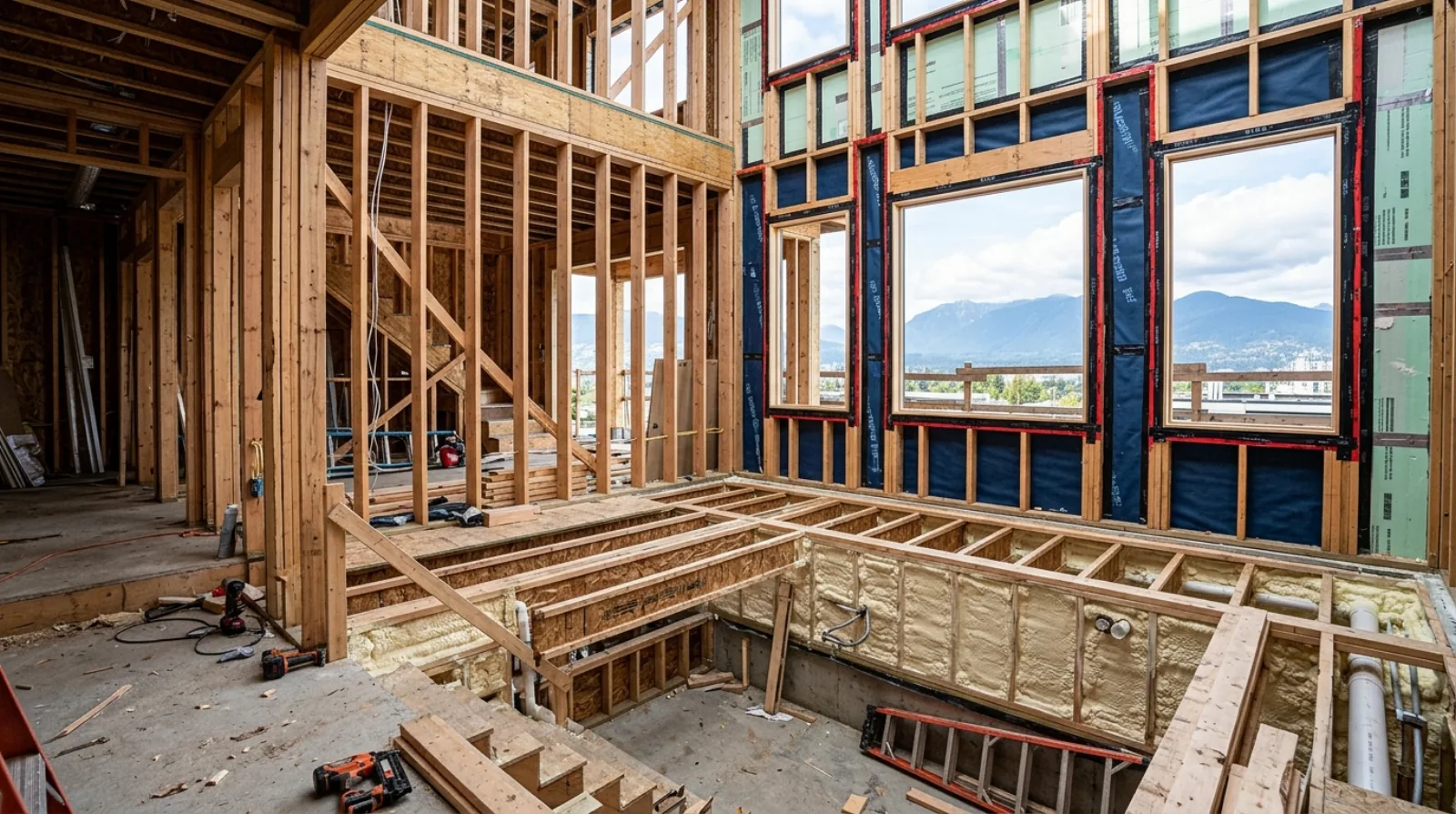
In framing, hitting Step 3 means we're using a designated air barrier (often the exterior sheathing taped at every joint, or a fluid-applied membrane) and we're treating every transition between assemblies, wall-to-roof, wall-to-window, wall-to-foundation, as a sealing detail to be drawn and inspected. Drywall as the air barrier is a strategy of last resort. The same detailing scales toward Step 5, the difference is in how exact the execution has to be at every penetration.
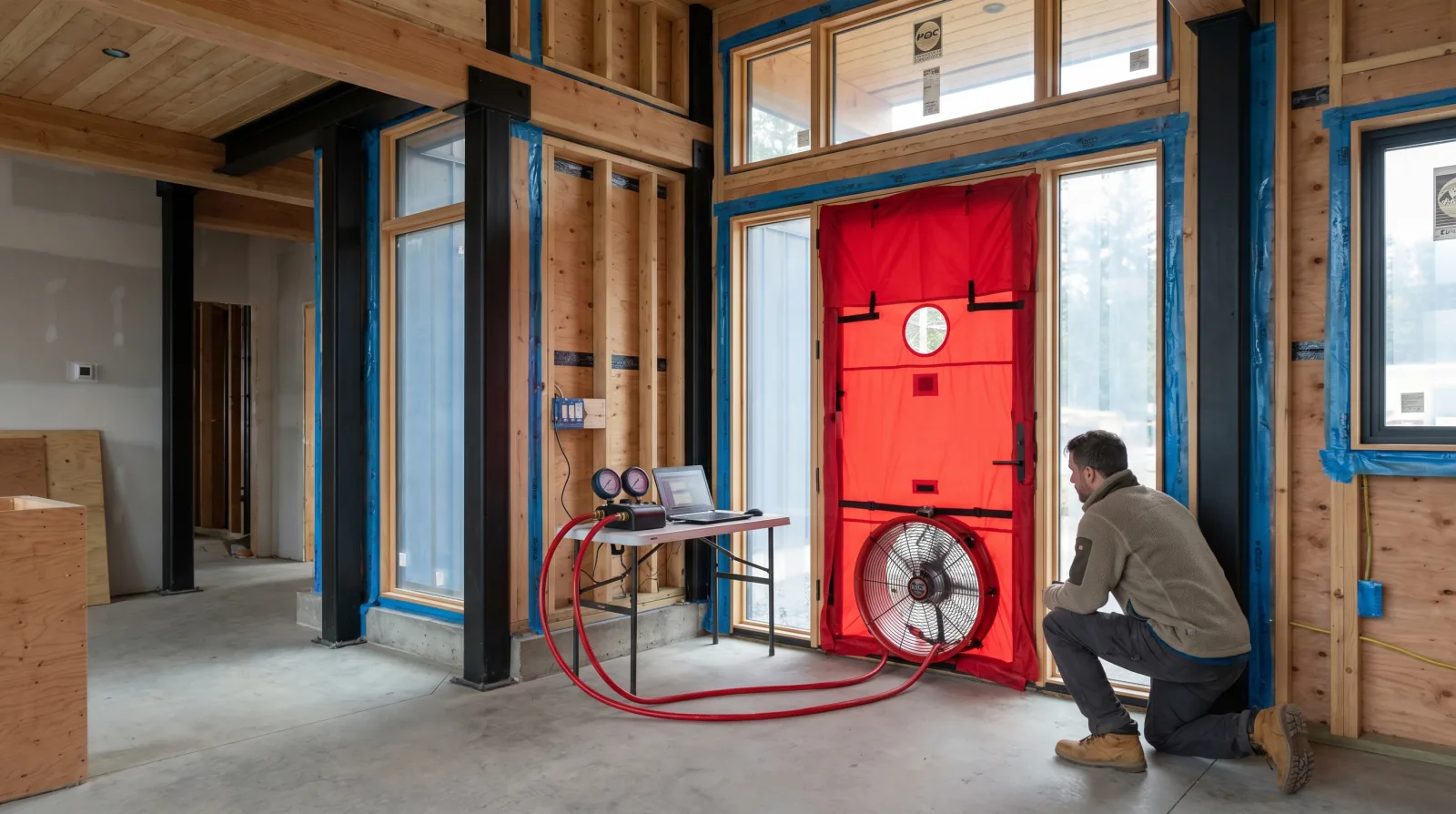
The blower-door test happens once before insulation and finishes go in (so leaks can still be repaired) and once at completion. We've watched well-intentioned framing crews deliver 2.4 ACH50 on the rough test, fine for Step 3, not Step 5. The remediation between rough and final isn't free, and it's why we now pre-brief the framing crew on the air-barrier strategy at the design coordination meeting, not when the wall is up.
Envelope decisions that get you to Step 3, and most of the way to Step 5
A Step 3 wall in the BC south coast climate is most commonly built one of three ways, and the same assemblies, tuned for tighter execution, take you toward Step 5:
- 2x6 framing with continuous exterior insulation. The structural cavity is filled with batt or dense-pack cellulose, and 2 to 4 inches of rigid mineral wool or polyiso is applied outboard of the sheathing. This is our default in most Burnaby builds.
- Double-stud wall. Two 2x4 walls separated by an air gap, deeply insulated. More expensive in framing but eliminates thermal bridging through studs, and is the more common assembly when builders are reaching for Step 5.
- Structural insulated panels (SIPs). Less common; works well on simple geometries.
Roof assemblies similarly require continuous insulation strategies, overframed cathedral roofs with 12 to 16 inches of insulation are typical. Foundations require sub-slab insulation (usually 2 to 3 inches of EPS) and full-depth perimeter insulation, plus a vapour barrier above the slab.
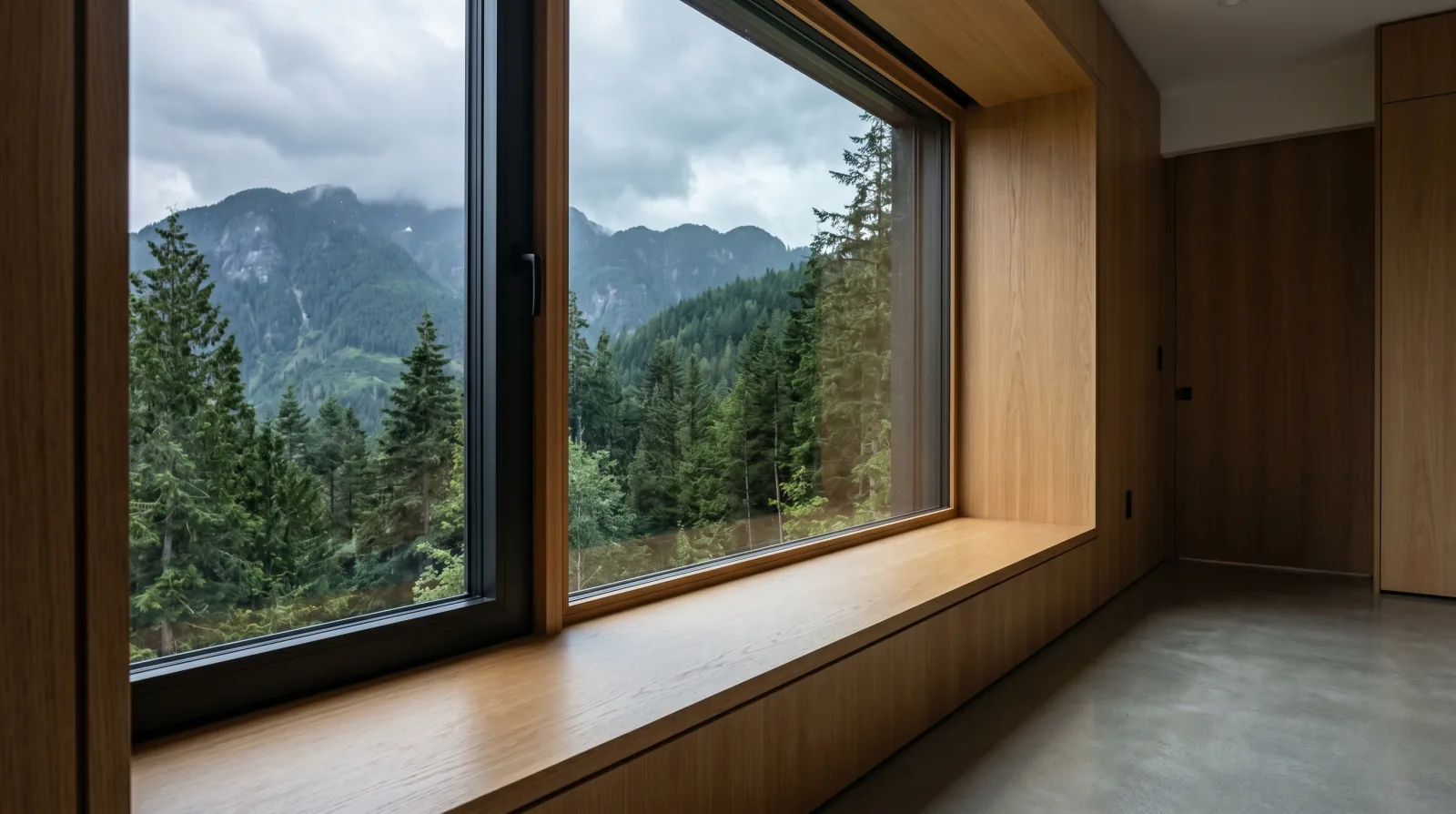
Windows are the weakest link in the envelope on every house. Step 3 + EL-4 is generally achievable with a high-performance double-pane assembly in fiberglass or aluminum-clad wood frames. Builders reaching for Step 5 typically move to triple-pane with high-performance frames. Vinyl frames usually underperform both targets. We cover this in more depth in our piece on windows and glazing for a Burnaby winter.
Mechanical ventilation when the house is sealed
A Step 3 + EL-4 house is too tight to ventilate by accident, and a Step 5 house even more so. You cannot rely on leaky construction to deliver fresh air anymore, by design, the house doesn't leak meaningfully. That means continuous balanced mechanical ventilation, almost always a heat-recovery ventilator (HRV) or energy-recovery ventilator (ERV), is non-negotiable.
The HRV pulls stale air from the kitchen, bathrooms, and laundry; supplies tempered fresh air to the bedrooms and living spaces; and recovers most of the heat from the outgoing stream. In Burnaby's climate, an HRV (rather than an ERV) is typically the right call for new builds. Sizing follows the HRAI guidelines and the requirements in CSA F326. Commissioning is part of the building permit closure, not optional.
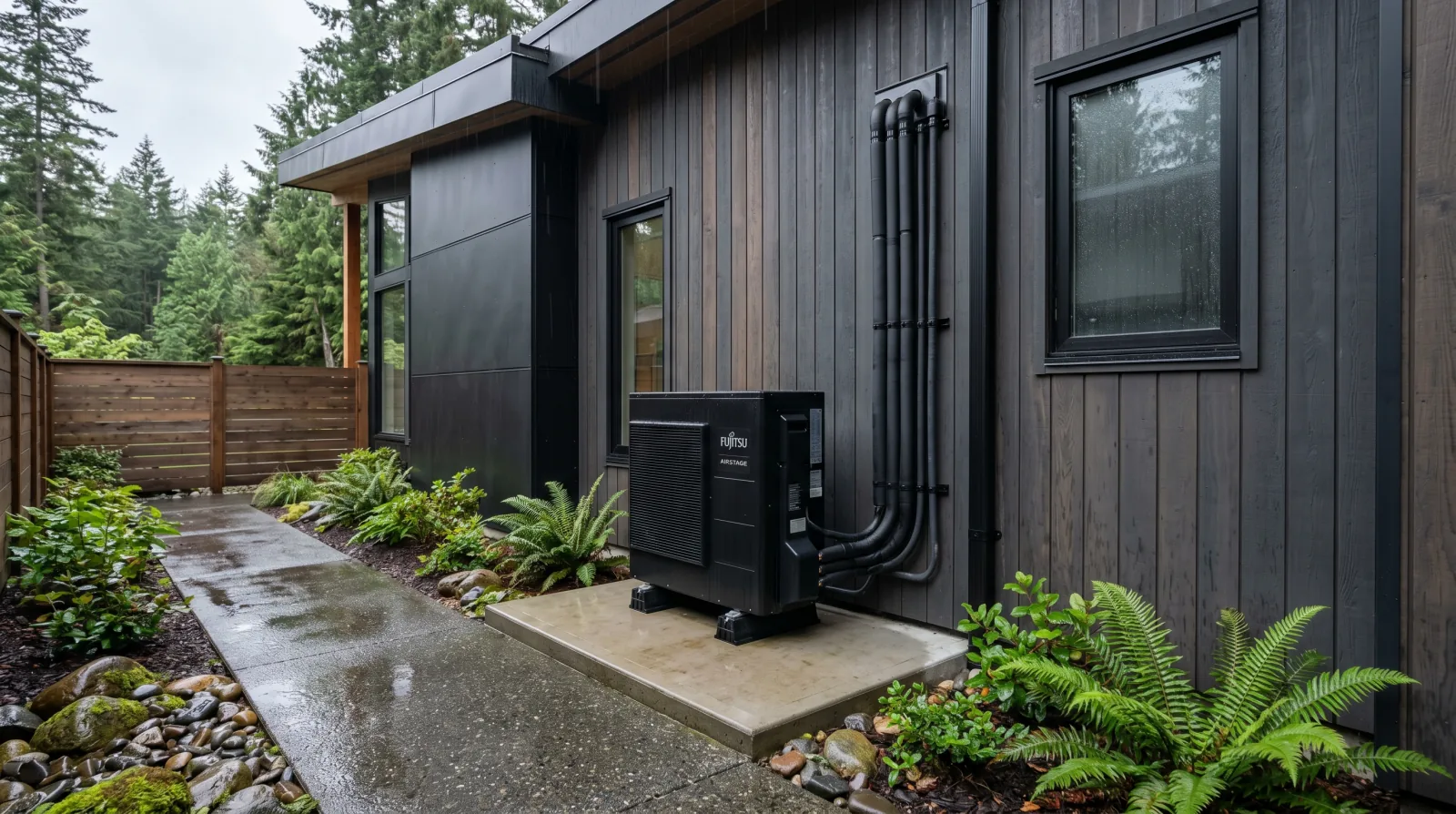
The EL-4 piece of Burnaby's code requirement is what drives the heat-pump conversation alongside the HRV. EL-4 effectively bans fossil-fuel space-heating and water-heating equipment in new construction, so the heat pump and HRV become the integrated mechanical core of the house. For a deeper look at how heat pumps and HRV/ERV systems integrate in a Burnaby Step 3 + EL-4 build, see our companion post on heat pumps and HRV in a modern Burnaby custom home.
Performance vs prescriptive
The BC Building Code allows two paths to compliance. The performance path uses energy modelling (HOT2000 or equivalent) to demonstrate the home meets the MEUI and TEDI limits. The prescriptive path publishes a specific recipe, wall, roof, window, mechanical ratings, that, if followed, deems compliance.
For Step 3 + EL-4, and even more so for Step 5, the performance path is almost always more flexible and more economical. It lets the design team trade, better windows for less wall insulation, for instance, based on what makes sense for the lot, the orientation, and the architecture. We work with an energy advisor registered with Natural Resources Canada from schematic design forward, not after drawings are done.
The energy advisor's role, and when to bring one in
The energy advisor is the professional who produces the HOT2000 energy model, submits compliance documentation to the City, and conducts the blower-door tests. In most markets outside BC, the energy advisor shows up late, after drawings are complete, sometimes after permit is submitted. That's the wrong time.
At Step 3 + EL-4, the energy advisor needs to be on the team from schematic design, and the requirement only tightens if you're reaching for Step 5. The reason is orientation. A west-facing wall of glass that looks beautiful on a north-facing lot performs very differently than it does on a south-facing one. The energy model tells you which design decisions make a real difference and which don't. We share the schematic energy model with the homeowner at design development, not as a compliance checkbox, but as a design tool. It shows where the energy is going and where the intelligent investments are.
The advisor also does the pre-drywall blower-door test, before insulation is sprayed, before drywall goes up, while the frame is still accessible. This is when leaks in the air-control layer can still be fixed cheaply. A failed pre-drywall test is not a crisis; it's a correction list. A failed test at occupancy means cutting drywall.
Ask any builder you're considering: do you bring the energy advisor in at design, or after permit? The answer tells you whether Step Code is part of how they build or a compliance problem they solve at the end.
Building beyond the current minimum
The honest framing here, without dollar figures (a budget conversation is a private one): the decisions that move a home from Step 3 + EL-4 toward Step 5 are concentrated in two places, the window specification and the air-barrier execution. Both are decisions made at design, not at finish. A builder who's planning for Step 5 from schematic can hold the path open at minimal incremental complexity. A builder who's only planning for Step 3 can't easily upgrade mid-build.
What building tighter buys, regardless of which Step you stop at: a home that costs less to heat and cool, that has no cold walls or condensation problems in winter, that is acoustically quieter because the envelope is tight, and that will sit on the right side of the code as the provincial baseline moves to Step 5 by 2032. Windows and envelope are the decisions with the longest lives in a custom home, the choices made now will still be in the walls thirty years from now.
Working with a builder fluent in Step Code
Step Code reveals which builders have updated their methods and which haven't. The signs we look for in colleagues, and that homeowners can ask about:
- Does the builder do a pre-drywall blower-door test? If not, the final number is a guess.
- Does the builder coordinate the air-barrier strategy with the framing crew before framing starts? If the strategy lands when walls are up, it's already late.
- Does the builder name an energy advisor on the team from schematic design?
- Has the builder delivered Step 3 + EL-4 homes (or higher) in the local market, Burnaby, Vancouver, Coquitlam, North Vancouver? Hot climates and prairie dryness behave differently than the BC south coast's wet winters.
A builder fluent in Step Code is also fluent in moisture management. The same techniques that make a house airtight can trap moisture if vapour-management isn't right for the climate. The west coast doesn't forgive this kind of mistake.
What this means for you as a homeowner
You don't need to memorize ACH50 numbers or read Section 9.36 of the BC Building Code. What you should ask any builder you're interviewing for a Burnaby custom home is: show me the airtightness number on your last three completed homes, and tell me how you got there. The answer separates the builders who hit the Step 3 + EL-4 target every time from the builders who get close and ask for a code variance at the end.
If you're early in design and want to understand how Step 3 + EL-4, and the path toward Step 5, will shape the choices you'll make over the next year, reach out. We'll walk you through what the envelope, mechanical, and finish decisions look like at each performance level, and where the homeowner has flexibility. For the broader context on what changes in the construction process when performance is measured, why we don't believe in builder-grade and materials that age beautifully cover the durability side of the same conversation.
Related on the Journal